


Outdoor fire pits are no longer just backyard accessories. They are architectural features, social anchors, and long-term investments in outdoor living. As patios evolve into fully designed outdoor rooms, the choice of fire pit material has become just as critical as choosing flooring, furniture, or lighting.
Among all available options, Corten steel fire pits and concrete fire pits dominate the high-end and professional landscape design market. Both are visually striking. Both are durable. Both appear regularly in luxury homes, hospitality projects, and architectural showcases.
Yet they are fundamentally different in material behavior, aging process, safety characteristics, maintenance requirements, cost structure, and long-term ownership experience.
This article goes far beyond surface-level comparisons. Drawing from material science principles, real-world outdoor performance, and professional installation experience, this guide aims to answer one question clearly:
Which lõkkeplats material is actually better for your space, climate, lifestyle, and long-term goals—Corten steel or concrete?
By the end of this article, you will understand not only what to choose, but why—with confidence grounded in experience, not marketing claims.

Understanding the Materials at Their Core
What Is Corten Steel?
Corten steel, often referred to as weathering steel, is a specialized alloy developed to intentionally rust—but in a controlled and protective manner. Corten steel is classified as weathering steel under ASTM standards, which define its corrosion-resistant performance for long-term outdoor use.
Unlike ordinary carbon steel, Corten contains alloying elements such as copper, chromium, and nickel. When exposed to the elements, it forms a dense oxide layer (patina) that:
- Prevents deeper corrosion
- Seals the underlying steel
- Eliminates the need for paint or coatings
This patina is not a defect—it is the material’s primary protection system.
Originally engineered for bridges, railcars, and industrial architecture, Corten steel has become popular in modern landscape design due to its:
- Warm, earthy color tones
- Sculptural presence
- Minimal maintenance requirements
What Is Concrete in Fire Pit Construction?
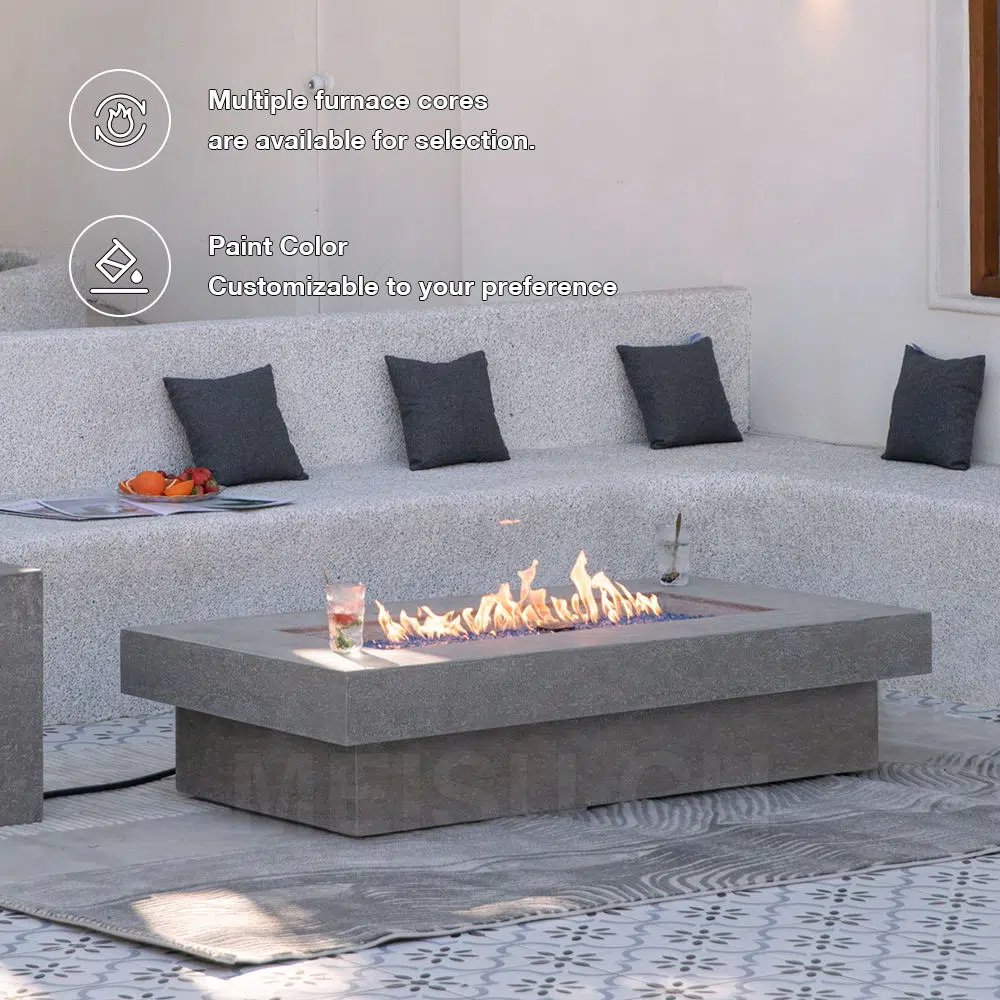
Concrete fire pits are typically made from cast concrete or GFRC (Glass Fiber Reinforced Concrete).
Concrete is a composite material consisting of:
- Cement
- Aggregates (sand, gravel)
- Water
- Optional reinforcement (steel rebar or fiberglass)
GFRC improves on traditional concrete by reducing weight and increasing tensile strength, allowing for thinner walls and more refined shapes.
Concrete fire pits are prized for:
- Clean, modern aesthetics
- Custom shapes and sizes
- Neutral color palettes
However, concrete behaves very differently from steel when exposed to heat, moisture, and freeze-thaw cycles—differences that matter greatly over time.
Aesthetic Philosophy: How Each Material Shapes Space
Corten Steel: Organic, Architectural, and Time-Evolving
Corten steel fire pits have a presence that feels grounded and architectural. The patina evolves from raw steel to deep oranges, browns, and umbers, creating a living surface that responds to its environment.
Key aesthetic qualities:
- Complements natural landscapes (stone, wood, plants)
- Pairs exceptionally well with modern and industrial architecture
- Looks better with age rather than worse
- Feels intentional, not decorative
Each Corten fire pit becomes visually unique over time. No two patinas are identical.
Concrete: Minimalist, Neutral, and Static
Concrete fire pits emphasize clean lines and consistency.
Their aesthetic advantages include:
- Uniform appearance
- Excellent compatibility with modern and minimalist designs
- Ability to match surrounding concrete elements (walls, pavers, seating)
- Custom color pigmentation options
However, concrete does not evolve visually. Any staining, cracking, or discoloration is typically perceived as damage rather than a characteristic feature.
Heat Performance and Fire Safety
Thermal Behavior: Steel vs. Concrete
Corten terasest
- Excellent heat tolerance
- Expands and contracts predictably
- Designed for high-temperature industrial use
- Rarely cracks under thermal stress
Betoon
- Poor tensile strength under thermal expansion
- Susceptible to micro-cracking
- Requires proper insulation between the flame and the structure
- GFRC improves performance but does not eliminate risk
Repeated heating and cooling cycles are inevitable for fire pits. Over time, this difference becomes significant.
Fire Safety Considerations
- Corten steel fire pits typically maintain structural integrity even after years of use
- Concrete fire pits require careful burner installation and insulation to prevent heat damage
- Poorly designed concrete fire pits can spall or crack when moisture is trapped and heated
From a safety and longevity perspective, steel has a natural advantage.
According to the U.S. Fire Administration (FEMA), outdoor fire pits should be placed at least 10 feet away from structures and combustible materials to reduce fire hazards.
Durability and Longevity in Real Outdoor Conditions
How Corten Steel Ages Outdoors
Corten steel is engineered specifically for outdoor exposure. Once its protective patina stabilizes:
- Corrosion slows dramatically
- Structural thickness remains intact for decades
- Maintenance is minimal
In many architectural applications, Corten steel structures last 50–80 years without coatings.
How Concrete Ages Outdoors
Concrete durability depends heavily on:
- Mix quality
- Reinforcement
- Climate
- Installation methods
Common long-term issues include:
- Surface cracking
- Water absorption
- Freeze-thaw damage
- Efflorescence (white mineral stains)
While high-quality concrete can last decades, fire pit applications accelerate wear due to heat stress.
Climate Performance: Where Each Material Thrives (or Struggles)
Cold Climates
- Corten Steel: Excellent resistance to freeze-thaw cycles
- Concrete: High risk of cracking if moisture penetrates
Coastal Environments
- Corten Steel: Not recommended due to salt acceleration of corrosion
- Concrete: Performs better with proper sealing
Hot, Dry Climates
- Both materials perform well
- Corten develops stable patina quickly
- Concrete experiences fewer moisture-related issues
Wet or Humid Regions
- Corten performs well if drainage is adequate
- Concrete requires diligent sealing and maintenance
Maintenance Requirements: What Ownership Really Looks Like
Corten Steel Maintenance
- No painting
- No sealing
- Occasional debris removal
- Optional patina stabilization rinse during the first year
Long-term maintenance is nearly zero.
Concrete Maintenance
- Periodic sealing required
- Stain removal
- Crack monitoring
- Possible resurfacing over time
Concrete fire pits require ongoing care to maintain appearance.
Customization and Design Flexibility
Corten terasest
- Best for bold, simple geometries
- Laser-cut customization possible
- Limited color range (natural rust tones)
Betoon
- Virtually unlimited shapes
- Wide color options
- Can mimic stone or terrazzo
- Integrates well with seating and countertops
Concrete excels in custom, integrated designs.
Cost Analysis: Initial vs. Lifetime Cost
Upfront Cost
- Concrete fire pits are often cheaper initially
- Corten steel fire pits may cost more due to material thickness and fabrication
Lifetime Cost
- Corten steel often wins due to negligible maintenance
- Concrete costs increase with sealing, repairs, or replacement
Over 10–20 years, Corten steel can be the more economical choice.
Environmental Impact and Sustainability
Corten terasest
- 100% recyclable
- Long lifespan reduces replacement waste
- No chemical coatings required
Betoon
- High carbon footprint during cement production
- Difficult to recycle
- Repairs often involve additional materials
From a sustainability perspective, Corten steel often aligns better with long-term environmental goals.
Common Myths and Misconceptions
“Corten Steel Will Rust Away”
False. The patina protects the steel.
“Concrete Is Fireproof”
Concrete is fire-resistant, not fireproof. Heat damage is common over time.
“Steel Fire Pits Get Too Hot”
Proper design and insulation mitigate surface temperature risks.
Which Fire Pit Is Right for You?
Choose Corten Steel If You:
- Value longevity and low maintenance
- Appreciate natural aging materials
- Want a bold architectural statement
- Live in non-coastal climates
Choose Concrete If You:
- Need custom shapes or integrated seating
- Want color matching with hardscape
- Are you comfortable with periodic maintenance
- Prefer minimalist, static aesthetics
No Universal Winner—Only the Right Context
There is no objectively “better” fire pit material—only a better choice for your specific needs.
Corten steel fire pits excel in durability, aging gracefully, and long-term value.
Concrete fire pits shine in customization, design integration, and aesthetic control.
The most trusted outdoor spaces are not built on trends—but on materials chosen with foresight, climate awareness, and honest understanding of how things age.
When chosen correctly, either material can anchor an outdoor space for decades—not just seasons.
Korduma kippuvad küsimused
Which fire pit lasts longer, Corten steel or concrete?
In most outdoor environments, Corten steel fire pits last longer.
Corten steel is designed for decades of outdoor exposure and high heat, while concrete fire pits often require repairs or resealing over time due to thermal stress and moisture absorption.
Do Corten steel fire pits rust completely through?
No.
Corten steel does not rust through under normal conditions. Its rust layer forms a stable, protective barrier that slows further corrosion. This is why Corten steel is used in bridges, buildings, and outdoor sculptures worldwide.
Are concrete fire pits safe for wood-burning fires?
Yes, but only when properly designed.
Concrete fire pits must include heat-resistant liners or burners. Without proper insulation, direct flame exposure can cause cracking or spalling due to trapped moisture and thermal expansion.
Which fire pit material is better for cold climates?
Corten steel fire pits perform better in cold climates.
They tolerate freeze–thaw cycles without cracking. Concrete fire pits are more vulnerable to cracking if water penetrates the material and freezes.
Are Corten steel fire pits safe to touch?
Like all fire pits, surfaces can become hot during use.
However, Corten steel fire pits cool down predictably after use. Safety barriers, fire screens, and proper clearance should always be used regardless of material.
Do concrete fire pits crack over time?
Yes, cracking is common over time.
Even high-quality concrete or GFRC fire pits may develop hairline or structural cracks due to repeated heating, cooling, and environmental exposure.
Which fire pit requires less maintenance?
Corten steel fire pits require less maintenance.
They do not need sealing, painting, or coatings. Concrete fire pits usually require periodic sealing and cleaning to maintain appearance and structural integrity.
Can Corten steel fire pits be used in coastal areas?
Corten steel is not recommended for coastal or high-salt environments.
Salt accelerates corrosion and prevents the protective patina from stabilizing. In coastal regions, sealed concrete or stainless steel fire pits perform better.
Which fire pit material is more environmentally friendly?
Corten steel is generally more sustainable.
It is fully recyclable, requires no chemical coatings, and has a long lifespan. Concrete has a higher carbon footprint due to cement production and is difficult to recycle.
Are concrete fire pits cheaper than Corten steel fire pits?
Concrete fire pits often have a lower upfront cost, but higher long-term maintenance expenses.
Corten steel fire pits may cost more initially, but typically offer lower lifetime ownership costs.
Which fire pit looks better over time?
Corten steel fire pits improve aesthetically with age as the patina deepens.
Concrete fire pits tend to show wear, stains, and cracks over time, which many owners consider undesirable.
Can both fire pit types be used with gas burners?
Yes.
Both Corten steel and concrete fire pits are compatible with natural gas or propane systems when professionally installed and properly ventilated
Is Corten steel fire pit rust harmful to surrounding surfaces?
During early patina formation, rust runoff can stain nearby surfaces.
Proper installation, drainage, and initial patina stabilization prevent long-term staining issues.
Which fire pit material is better for modern landscape design?
Both materials work well in modern designs.
Corten steel suits industrial, architectural, and natural-modern styles, while concrete works best in minimalist and integrated hardscape designs.
How long does a Corten steel fire pit take to develop its patina?
Typically 3 to 12 months, depending on climate and exposure.
The patina stabilizes faster in dry environments and slower in humid or shaded areas.





 Estonian
  English (United States)
  English (New Zealand)
  Spanish (Spain)
  French (France)
  Swedish
  South Azerbaijani
  Greek
Greek  German
  Italian
  Hebrew
  Georgian
  Indonesian
  Japanese
  Korean
  Lithuanian
  Moroccan Arabic
  Bengali
  Welsh
Welsh  Hungarian
  Romanian
  Russian
  Panjabi
  Portuguese
  French (Canada)
  Spanish (Guatemala)
  English (South Africa)
  German (Switzerland, Informal)
  Spanish (Mexico)
  Norwegian
  Thai
Thai  Armenian
  English (UK)
  English (Australia)
  English (Canada)
  Afrikaans
  Aragonese
  Amharic
  Vietnamese
  Chinese